BOOK EXCERPT · Part I · Environment
The sand beneath the growth
Download this excerpt as PDF ↓
The gap between waste generation and recovery also invites us to follow the material chain in the other direction. Before an object is discarded, its raw materials have already been taken from somewhere. Moving from electronic waste to sand brings this earlier stage into view, through the rivers, quarries and coasts that supply construction.
Sand provides another reminder that a resource problem is not always a simple global shortage. UNEP’s 2026 assessment describes annual sand use on the order of 50 billion tonnes. Sand suited to a particular industrial use is not interchangeable with every grain on the planet, and extraction can damage a river or coast long before the world “runs out” of sand. Location, material properties and the rate of ecological replenishment matter. [I.18]
To place today’s demand in perspective, the next figure sets sand and gravel within the longer expansion of mineral use. A complete, comparable century-long record of sand alone is not available here, so the two views remain separate: the historical curve covers non-metallic minerals more broadly, while the adjacent points give published estimates for sand and gravel. The broad curve provides context, not a substitute sand-consumption series. [I.29–I.31]
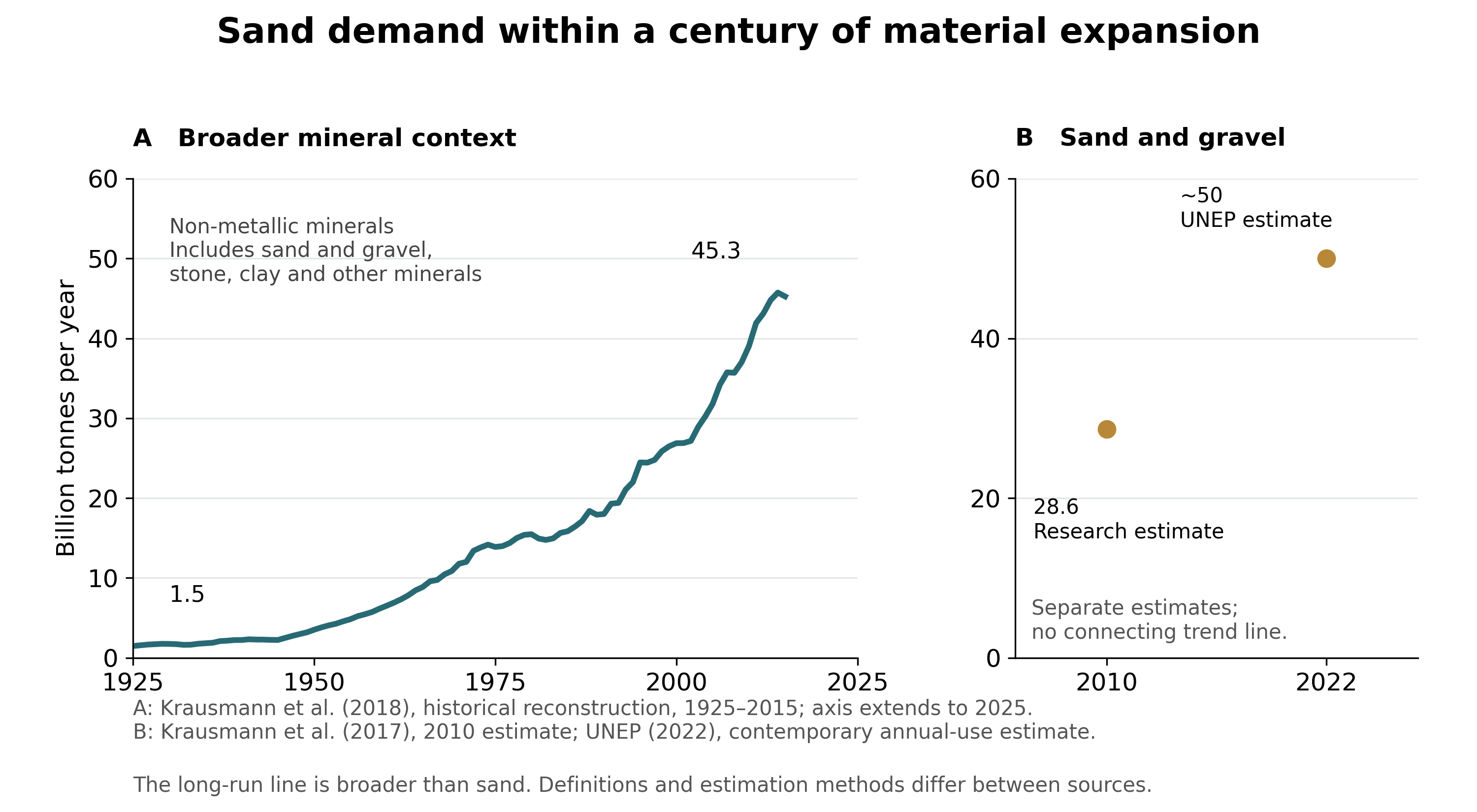
Figure I.15a. Sand demand within a century of material expansion. Left: reconstructed global extraction of non-metallic minerals, 1925–2015, on a 1925–2025 axis; this includes sand and gravel as well as other minerals. Right: separate sand-and-gravel estimates—28.6 billion tonnes of primary material inputs in 2010 and UNEP’s approximately 50 billion tonnes used annually, reported in 2022. Different scopes and methods prevent treating these points as a harmonised trend or calculating a growth rate between them. [I.29–I.31]
Behind these large quantities are familiar things: homes, roads, hospitals and expanding cities. Concrete requires sand and gravel, while infrastructure construction adds further demand for aggregates. The useful services they provide help explain the demand, but the consequences depend on where and how the material is taken. Extraction can erode riverbanks and coasts, damage habitats and weaken natural protection from storms. UNEP’s proposals include better monitoring, reuse of construction materials and extraction rules adapted to each place. [I.31]
Following sand from a riverbed into a building therefore leads us beyond tonnes and construction costs. The place it leaves behind is also a living habitat. Understanding the full consequences of material growth requires considering what happens to the species that depend on such places. The amphibian example from the first book takes us into that question, with the same need to distinguish evidence from assumption.